 Snorkeling Zanzibar
What Will You See Snorkeling in Zanzibar?
What will you see snorkeling in Zanzibar comes down to three honest tiers: sergeant majors, anemonefish and sea stars on almost every trip, snappers and moray eels on most of them, and turtles or rays only on a lucky day, whatever a tour's marketing photos promise. Zanzibar's waters hold over 600 fish species and around 50 coral types archipelago-wide, with Mnemba Atoll's protected reef alone accounting for over 400 of them. This guide ranks the sightings by realistic likelihood, names exactly which reef each one favors, and is plain about the reef condition and the two things most first-timers wrongly expect.
Quick answer
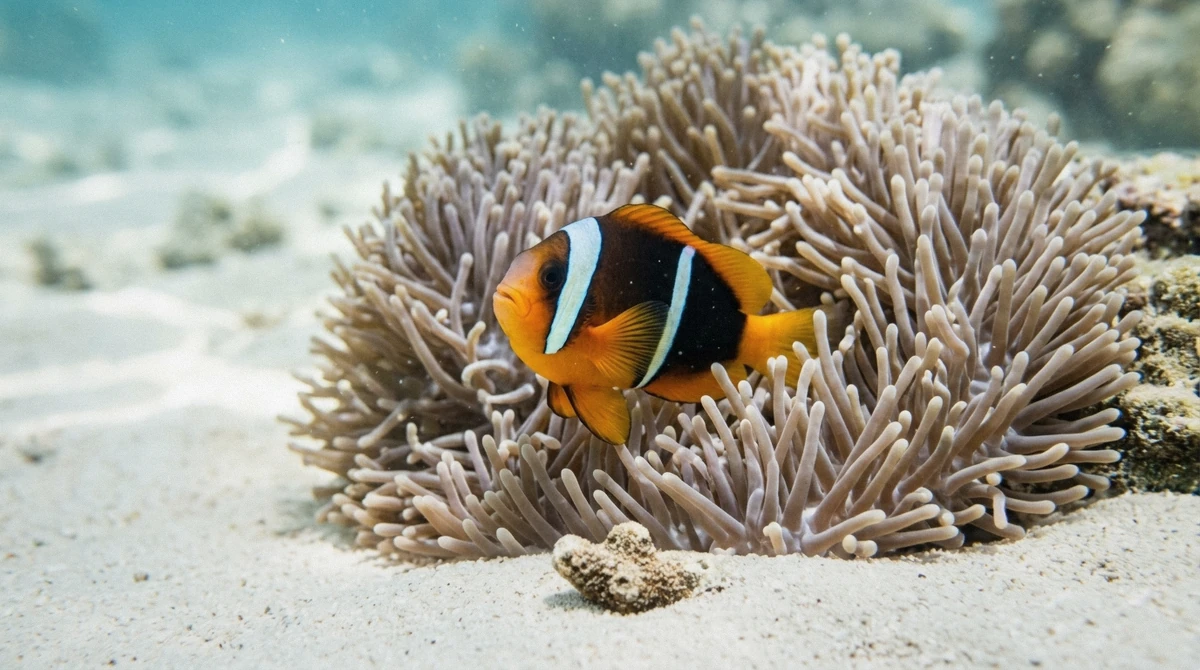
Snorkeling in Zanzibar, you'll almost always see sergeant majors in loose schools and twobar anemonefish or skunk clownfish sheltering in anemones, very often snappers, surgeonfish and moray eels, and on a good day one of the small, patient-viewing finds like a ribbon eel at Tumbatu. Turtles and rays are rare in the shallows, whatever a tour's highlight photo shows.
Key takeaways
- Sergeant majors and anemonefish are close to guaranteed around any anchored boat; see the full likelihood table below
- Turtles and rays are rare sightings in Zanzibar's shallows, a lucky-day event rather than a feature to expect
- Nungwi keeps rescued green turtles in a tidal lagoon, a different thing from a wild sighting on the reef and worth not confusing with one
- Tumbatu is the site for patient finds like ribbon eels and batfish, with far fewer boats than Mnemba
- Shallow reefs sit in average condition even inside the protected areas, and there have been no reported shark attacks in these waters
- The Dolphin and Tumbatu Island trip is the one bookable route built specifically around the quieter, healthier coral
At a Glance: the Realistic Sightings List
Rows are ordered by how likely a sighting actually is, strongest first, using a fixed scale rather than marketing language: nearly every trip, most trips, regular but not every trip, lucky-day sighting, or rare.
The pattern underneath the table: the smaller, stationary reef residents are consistent, and the larger, mobile animals are the ones that vary trip to trip.
| Species / sight | Where in Zanzibar | Best months | How likely |
|---|---|---|---|
| Sergeant majors | Around any anchored boat: Mnemba, Tumbatu, Nakupenda | Year-round | Nearly every trip |
| Twobar anemonefish and skunk clownfish | Anemones at Mnemba Atoll and Tumbatu | Year-round | Nearly every trip |
| Red-knobbed starfish and pentaceraster sea stars | Sandy patches near Mnemba and Nakupenda | Year-round | Most trips |
| Snappers, surgeonfish and Moorish idols | Mnemba Atoll reef | Year-round | Most trips |
| Moray eels and lionfish | Reef crevices at Mnemba and Tumbatu | Year-round | Regular but not every trip |
| Powder blue tang, palette surgeonfish, Arabian angelfish | Mnemba Atoll | Year-round | Regular but not every trip |
| Ghost pipefish, cowfish, razorfish, cleaner shrimp, nudibranchs | Tumbatu, for patient searchers | Year-round | Lucky-day sighting |
| Ribbon eels and batfish | Mwana wa Mwana islet, off northern Tumbatu | Year-round | Lucky-day sighting |
| Green turtles | Open reef at Mnemba and Tumbatu, not the Nungwi lagoon | Year-round | Rare |
| Rays | Sandy channels near Mnemba | Year-round | Rare |
| Humpback whales, seen from the boat rather than while snorkeling | Crossing to Mnemba or Kizimkazi | July to November | Lucky-day sighting |
What Lives on the Shallow Reef
The near-certain sightings
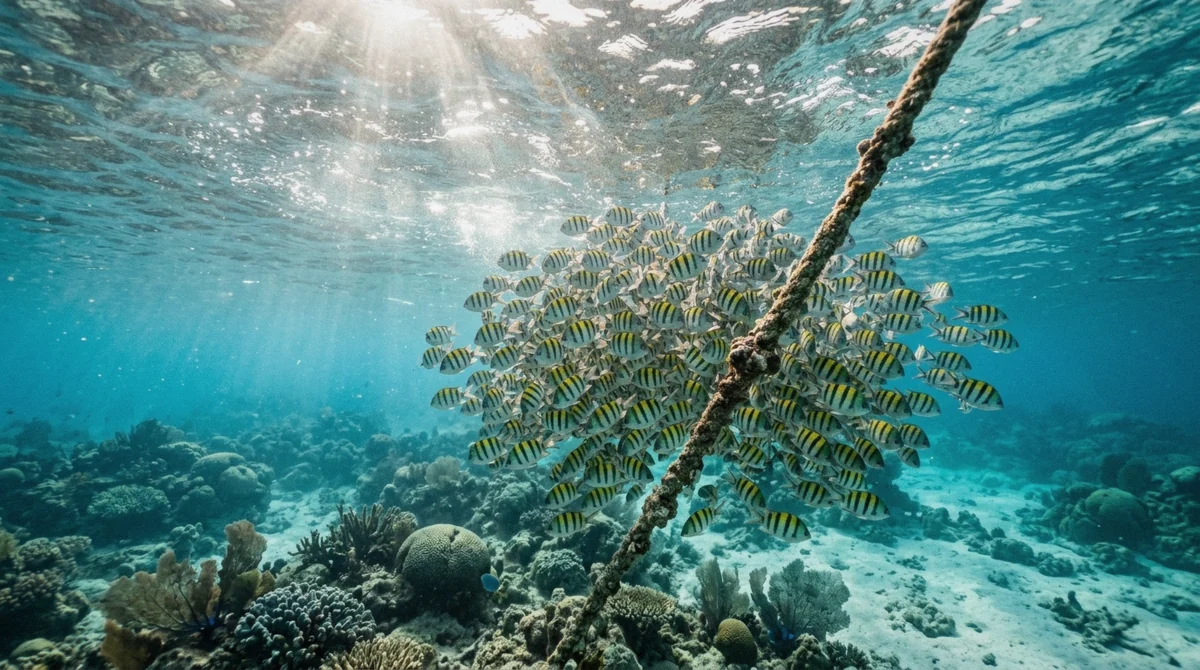
Sergeant majors show up in the hundreds around almost any anchored boat, a loose silver-and-black-striped school that gathers wherever a hull sits still for more than a few minutes. Twobar anemonefish and skunk clownfish, Zanzibar's two resident clownfish species, shelter in host anemones on the shallow reef at Mnemba and Tumbatu, often sharing the same anemone with a porcelain crab or a cluster of threespot dascyllus. Red-knobbed starfish and pentaceraster sea stars sit out on open sand near both sites, easy to spot even for a first-time snorkeler still finding their bearings, alongside close to a dozen sea-urchin species tucked into reef crevices.
None of these require any searching technique to find; they're simply present in the water column and on the sand around the boat from the moment a snorkeler enters.
The regular reef fish
Beyond the near-certain layer, Mnemba's reef regularly turns up snappers, surgeonfish and Moorish idols moving in loose groups over the coral, with moray eels and lionfish more often found tucked into crevices than swimming in the open. Powder blue tang, palette surgeonfish, Arabian angelfish and blackspotted rubberlip round out the common list, all genuinely likely on a given trip but not guaranteed on every single one the way the sergeant majors and anemonefish are.
Why the shallow depth matters for spotting them
Mnemba's reef sits at roughly two to five metres, shallow enough that most of this list is visible from the surface without diving down, which is part of why the near-certain and common tiers stay reliable across so many trips. A snorkeler floating flat and still for a minute over a patch of coral, rather than kicking steadily past it, tends to notice more of the regular reef fish simply because startled fish that dart from a passing shadow often reappear once the water settles.
The Small Stuff Worth Slowing Down For
Finds that reward a patient look
A handful of species only turn up for snorkelers willing to slow down and actually search rather than swim past: robust ghost pipefish, roundbelly cowfish, jointed razorfish, banded cleaner shrimp, juvenile sweetlips, nudibranchs and leaf fish. None of these are common in the sense the reef fish above are, but a guide who knows where to look, moving slowly along a specific stretch of coral rather than covering distance, turns up several of them on a good day.
Tumbatu's specific draw
Ribbon eels and batfish are specifically a Tumbatu find, most often around Mwana wa Mwana islet off the reef's northern tip, where healthier coral and far fewer boats give the smaller, more easily disturbed species room to stay put. The Dolphin and Tumbatu Island Snorkeling trip is the one route on this catalog that reaches this stretch of reef directly, and its smaller 8-person boat cap suits the slower, more deliberate looking this tier of sighting actually needs.
What makes these finds harder
Nudibranchs and leaf fish in particular rely on camouflage as their main defense, so they stay motionless rather than fleeing, which means a snorkeler swimming at a normal pace over the same patch of reef can pass directly above one without noticing. A local guide's advantage here is less about knowing secret locations and more about having trained their eye to recognize the shapes that don't quite match the coral around them, a skill that takes repeated looking rather than luck alone. Juvenile sweetlips add a behavioral tell worth knowing: they hold an odd, twitching swimming style near the reef floor that experienced guides recognize from a distance, well before the pattern is obvious to a first-time snorkeler looking at the same patch of coral.
What You Probably Will Not See
Turtles and rays: a lucky day, not a feature
Turtles and rays are rarely encountered in Zanzibar's shallow snorkeling waters, whatever a tour listing's highlight photo promises. Treating either as a lucky-day bonus rather than an expected part of the trip is the honest way to book, and it avoids the single most common source of disappointment reported after a Zanzibar snorkel. A listing photo showing a diver alongside a ray or a turtle is very often a stock image or a shot from an exceptional day, not a representative preview of what a typical booking will produce.
The Nungwi lagoon is a different thing entirely
Nungwi keeps rescued green turtles in a tidal lagoon, a genuinely worthwhile stop but not a wild reef sighting, and the two get confused often enough to be worth stating plainly here: a photo of a turtle from Nungwi's lagoon is not the same experience, or the same odds, as spotting one on the open reef at Mnemba or Tumbatu.
Reef Condition, Stated Plainly
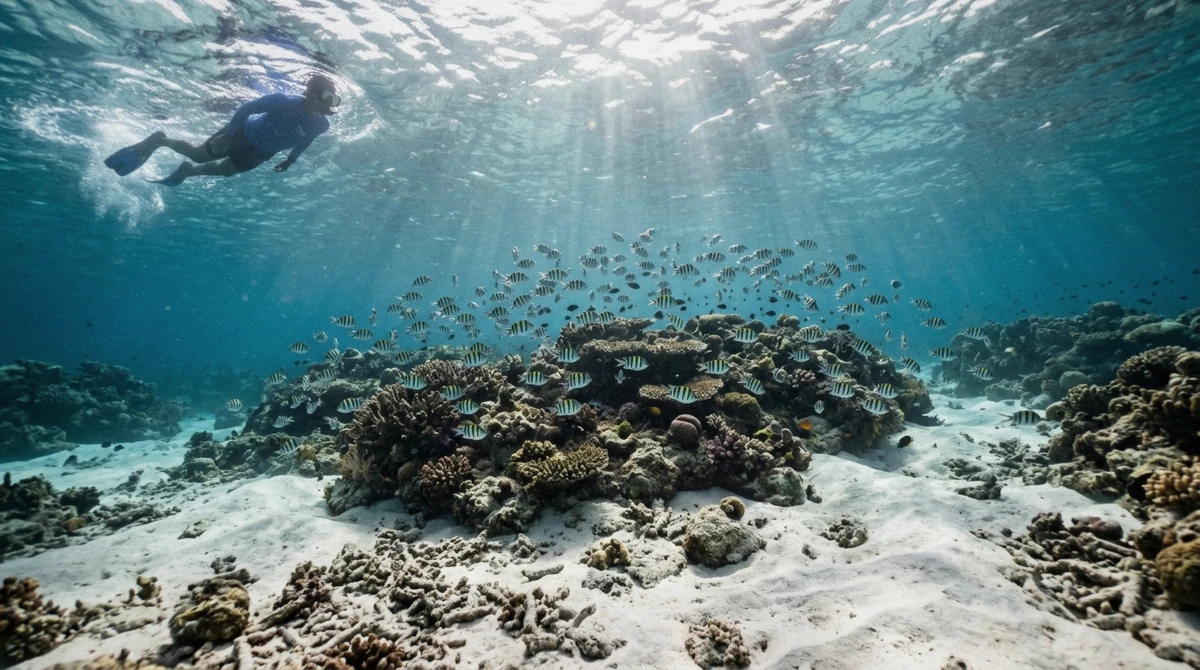
Zanzibar's waters hold over 600 fish species and around 50 coral types archipelago-wide, and Mnemba's protected reef alone accounts for over 400 fish species on its own, numbers that put the destination in genuinely serious company. The honest caveat is that shallow reefs sit in average condition even inside the protected marine areas, and the tidal flats especially can look poor at first glance to anyone expecting postcard-bright coral everywhere they look. Boat traffic and heat stress both play a part, and neither Mnemba nor Tumbatu is uniformly pristine end to end; the better coral tends to sit in specific patches a guide can find rather than blanketing the whole reef.
On the safety side, there have been no reported shark attacks in these waters, worth stating outright rather than leaving as background worry.
This is worth stating plainly against the comparison most travellers already have in their head: a reef holding well over 600 fish species is not a thin or disappointing one, but it is also not the uniformly saturated coral garden that a heavily filtered tour photo suggests. Setting expectations at average-but-genuinely-alive, rather than at either extreme, is closer to what a first snorkel actually delivers here.
Where Each Species Is Easiest to Find
The species lists above group by likelihood. This table flips the axis to reef, matching each site to what it's actually known for and which tour reaches it.
Four named sites cover almost every trip in the catalog, and each one has a genuinely different character rather than being interchangeable stops on the same reef.
| Reef | What you'll find here | Tour(s) that reach it |
|---|---|---|
| Mnemba Atoll | Anemonefish, snappers, surgeonfish, Moorish idols, moray eels, sea stars, over 400 fish species inside the protected area | Kendwa Mnemba, Private Mnemba, Mnemba half day |
| Tumbatu | Ribbon eels, batfish, leaf fish, nudibranchs; healthier coral, far fewer boats than Mnemba | Dolphin and Tumbatu Island Snorkeling |
| Menai Bay / Kwale | General reef fish along the Safari Blue route, plus a sandbank and lagoon stop | Safari Blue Lagoon Day Trip |
| Nakupenda / Changuu | A modest reef, best paired with the sandbank swim and Changuu's giant tortoises on land | Prison Island and Nakupenda Sandbank Tour |
The pattern holds across all four: Mnemba delivers the widest species count and the most consistent sightings, Tumbatu trades some of that consistency for quieter water and the patient-searcher finds, and Menai Bay and Nakupenda both bundle a lighter reef with a different kind of day out, whether that is a full dhow itinerary or a sandbank and tortoise stop.
How to See More
A handful of habits genuinely change how much of the list above shows up on a given trip.
Move slowly and let fish come back
The single biggest factor is speed. Reef fish scatter from a fast-moving shadow and reappear once the water settles, so a snorkeler who stops and floats over a promising patch of coral for a minute typically sees more than one who kicks steadily across the same distance. This matters most for the regular reef fish and the patient-search species; the near-certain sightings like sergeant majors are visible regardless.
Ask the guide before the water, not during
Guides on these trips know which specific coral heads have held an anemone family or a resident moray for weeks, information that is far more useful asked at the boat briefing than shouted underwater. A guide told in advance that ribbon eels or nudibranchs are the goal for the day will often steer the group toward the patches most likely to hold one, rather than a generic loop of the reef.
Look at the sand and the crevices, not just open water
Many of the best sightings on this list, starfish, urchins, cowfish, razorfish, sit on the sand or tucked into a crevice rather than swimming in open water where they're easy to spot by default. Scanning the sandy patches between coral heads, and the shaded undersides of overhangs, turns up considerably more than looking only at what's moving.
Time the trip for calm, clear water
Visibility decides how much of any given sighting is actually visible rather than a blur at distance, which is a separate question from whether the animal is present at all. A trip booked in one of the calmer, clearer months makes every tier on the list above easier to actually see well, detailed further on the linked best-time guide below.
When to See Them
None of the species above have a sharp seasonal window the way the humpback whales do, present close to the coast from July to November and essentially absent the rest of the year. Visibility is the bigger factor for everything else on this list: the calmer, clearer months make the near-certain and common sightings easier to actually see well, even though the animals themselves are present year-round. The full month-by-month breakdown, including sea temperature and the two windows worth avoiding, is on best time to snorkel in Zanzibar rather than repeated here.
Dolphins, and the Honest Version
Dolphins are the headline on four of the six compared trips, but a sighting is not guaranteed, and the full picture, including the ethics of how boats approach them, belongs on the Zanzibar reef guide on our homepage rather than repeated here. What's worth knowing from a sightings standpoint alone is that dolphins are wide-ranging animals, not reef residents, so an encounter depends on the pod's location that morning far more than on which operator is booked.
Whether the reef sightings alone justify the price of a trip, separate from the dolphin question entirely, is answered honestly on is snorkeling in Zanzibar worth it, which weighs the fish and reef condition described above against the fees and the crowd.
A trip that delivers dolphins and a strong reef showing on the same morning is a genuinely good outcome, but the honest planning approach is to treat the reef sightings above as the reliable part of the day and any dolphin encounter as the bonus layered on top of it, not the other way around.
What You'll See Snorkeling in Zanzibar: Questions Travellers Ask
What fish will I see snorkeling in Zanzibar?
Sergeant majors and the resident twobar anemonefish and skunk clownfish are close to guaranteed. Snappers, surgeonfish, Moorish idols, moray eels and lionfish are common but not on every single trip. Zanzibar's waters hold over 600 fish species in total, with Mnemba's protected reef alone accounting for over 400.
Are there turtles in Zanzibar?
Yes, but they are rare in the shallow snorkeling waters, a lucky-day sighting rather than something to expect. Nungwi separately keeps rescued green turtles in a tidal lagoon, a different and more reliable thing to see, but not the same as a wild reef encounter.
Is the coral in Zanzibar healthy?
It's mixed. Shallow reefs sit in average condition even inside protected marine areas, and tidal flats can look poor at first glance, though better patches of coral exist at both Mnemba and Tumbatu for a guide who knows where to look.
Where is the best marine life in Zanzibar?
Mnemba Atoll for sheer species count, over 400 fish species inside a no-fishing protected area. Tumbatu for a quieter, less crowded look at healthier coral and the patient-searcher finds like ribbon eels and batfish.
Are there sharks in Zanzibar?
There have been no reported shark attacks in these waters. Sharks are not a feature of the shallow snorkeling sites this catalog covers.
Will I definitely see dolphins snorkeling in Zanzibar?
No. Dolphins are wide-ranging and a sighting depends on where the pod happens to be that morning, not on the operator. The dolphin trips and the ethics of how they're approached are covered on the homepage.
Compare which of the six trips reaches the reef with the sightings that matter most to you.